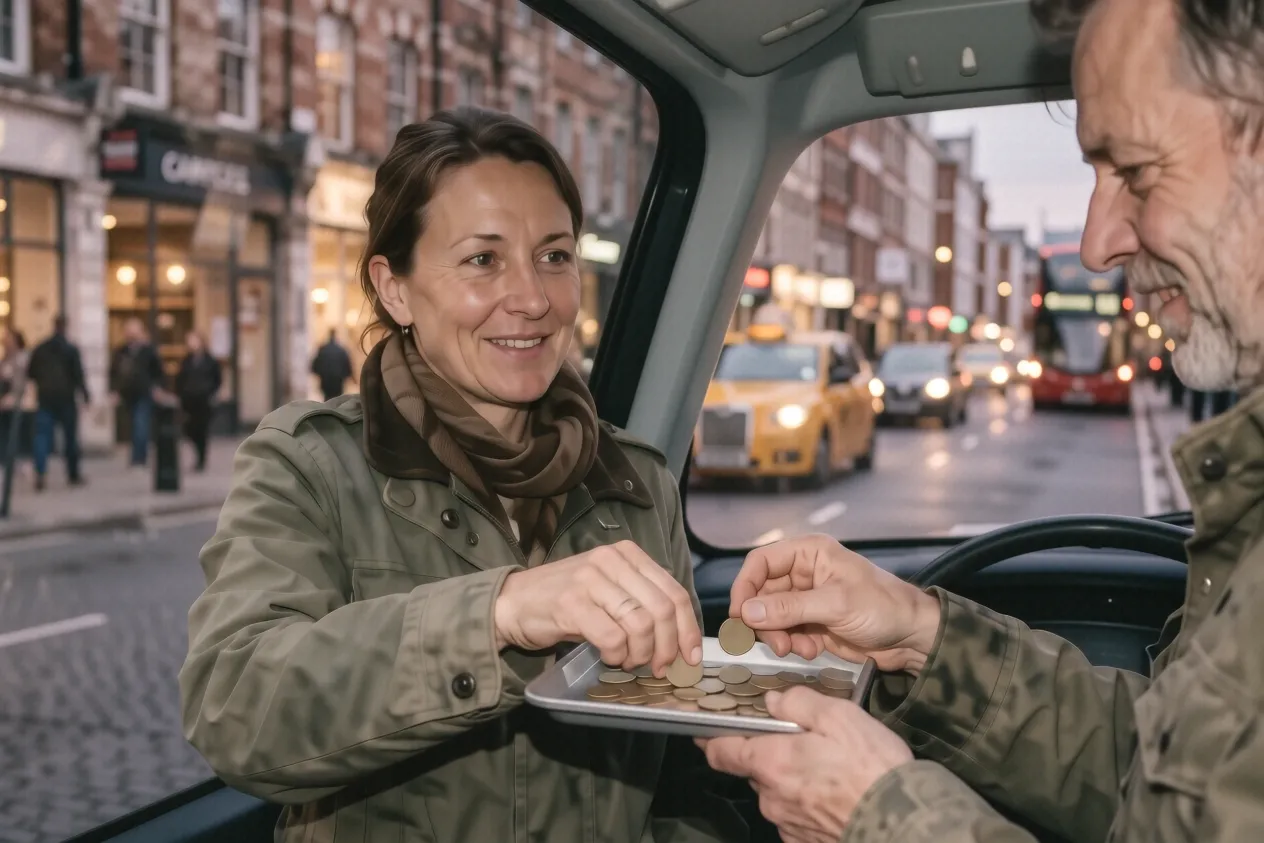
American tourists often arrive in London with a heavy hand for tipping. They expect to leave 20% or even 25% at every service point because that is the standard back home in New York or Chicago. In London, this approach feels excessive and can sometimes cause confusion during a quick transaction. Tipping exists here, but it follows much quieter rules. We have seen visitors struggle with the mental maths of British pounds while trying to match American generosity. It is rarely mandatory.
The standard London way
Tipping is largely discretionary. Most passengers simply round up to the nearest pound. If your fare from Mayfair to Hackney Wick comes to £18.40, leaving £20 is a perfectly acceptable gesture. This method keeps things simple for everyone involved.
You might choose to tip 10% if the service was excellent. While many people stick to rounding up, a slightly higher percentage shows genuine appreciation for a smooth ride. Drivers do not expect a large windfall every time they pull up to a curb.
Money is often handled via card now. Most TfL-licensed vehicles use modern card readers that allow for tip selection. You will usually see a prompt on the screen after the fare is calculated.
Comparing London to New York
The cultural gap is wide. In Manhattan, tips are often viewed as a necessary part of a worker’s base wage. London operates differently because most taxi drivers earn a steady income through regulated tariffs set by Transport for London.
Drivers do not rely on your spare change to survive. They follow the London Cab Order 1934 principles regarding how they charge for their time and distance. Because the rates are strictly controlled, the pressure to tip heavily is absent.
You should avoid the 20% habit. It can feel awkward when a driver sees a massive tip on a very short trip. A small gesture is better than an overwhelming one.
When to increase your tip
Sometimes extra effort deserves more money. If a driver helps you lift three heavy suitcases into a TX5 LEVC, a larger tip is appropriate. You might add an extra £2 or £3 for this physical labour.
Weather plays a part too. A driver who waits patiently in the pouring rain at Heathrow Terminal 5 deserves a bit more than usual. We suggest checking if the service went beyond basic driving.
Wheelchair-accessible cabs require specific handling. If the driver assists with a ramp or helps a passenger with mobility needs, tipping more than the standard 10% is a kind gesture. It acknowledges the extra care taken.
Black cabs versus private hire
Not all vehicles are equal. A traditional black cab is a licensed hackney carriage. These drivers have passed the famous “Knowledge” and can take any street route they choose.
Private hire vehicles, often called minicabs or Ubers, work differently. You usually book these through an app before the journey starts. The fare is fixed in advance, so there is no meter running.
Tipping an Uber is entirely optional. Since the price is set before you even enter the car, the driver has already known their profit margin. Many passengers skip tipping minicabs entirely unless the service was truly exceptional.
Handling digital payments and cash
Card machines are everywhere. You will find them in almost every modern black cab operating in the city. These machines often ask for a percentage or a fixed amount.
Cash is still useful. Some older drivers might prefer a few coins or a note left on the seat. If you use cash, ensure you have small denominations ready.
Check the receipt carefully. Sometimes a service charge is added by mistake, although this is rare in the taxi industry. Always confirm the final total before tapping your card.
Frequently asked questions
- Should I tip if the driver was rude?
- No, you are under no obligation to tip for poor service. Tipping is a reward for good work. If the driver was unprofessional or took an unnecessarily long route, simply pay the fare shown on the meter.
- Is 15% too much for a London taxi?
- It is on the high side. While not offensive, it is significantly higher than what most locals do. We suggest sticking to 10% or rounding up unless they performed extra tasks like carrying heavy luggage.
- Do I tip at the airport?
- Yes, tipping is common for airport transfers. If a driver helps you with bags from the terminal to the car, a tip of £5 to £10 is a generous way to say thank you.
- Can I pay for my tip with a contactless card?
- Most modern London taxis allow this. When the meter finishes, the card reader will usually offer a 'Tip' button. You can select a percentage or enter a specific amount before tapping your phone or card.
- What if the driver asks for a tip?
- This is highly unusual and generally against professional standards. If a driver pressures you for extra money, you should report the incident to Transport for London. Licensed drivers should never demand tips.
- Do I tip for short trips under £5?
- Rounding up is still fine. If the fare is £4.20, giving them £5 is a polite way to finish the transaction without fumbling for coins.
- Is there a difference between a taxi and an Uber in London?
- Yes, black cabs are licensed hackney carriages that can be hailed on the street. Ubers are private hire vehicles that must be pre-booked via an app. Tipping customs differ because cab fares are metered while Uber fares are fixed.
Published 29 July 2024. Last updated 11 May 2026.